Growing guides
Soil basics: why it matters more than anything else you'll buy

Soil basics: why it matters more than anything else you'll buy
Every garden centre wants to sell you something. Feed. Pellets. Slow-release granules. Compost accelerator. Fungal inoculants in little foil sachets. Some of it works. Most of it is unnecessary if the one thing underfoot is right.
The one thing underfoot is the soil.
The most important idea in vegetable growing is easy to miss because it sounds almost too simple: you're not growing plants, you're growing soil. The plants come as a by-product. "Feed the soil, not the plant" gets repeated until it sounds like a mantra — because it's true. Most beginners learn it the hard way, after a couple of frustrating seasons spent blaming the seeds, the weather, or their own thumbs. You can skip that lesson.
What soil actually is
Dirt is what gets tracked into the house. Soil is a living thing — half mineral, half biological, that took decades or centuries to form, even when it doesn't look like much.
A healthy garden soil is, very roughly, 45% mineral particles, 25% air, 25% water, and around 5% organic matter. That last 5% is where most of the action is. Organic matter holds water, feeds microbes, releases nutrients slowly, and gives soil its crumbly, dark texture. Everything you do to improve your soil, long-term, is a way of increasing that 5%.
Read what you've got
Before you spend money, spend ten minutes on a diagnosis. No lab needed — just a trowel, your hands, and your nose.
The squeeze test. Dig a spade-deep hole. Take a handful of moist soil from the bottom and squeeze it.
Falls apart the moment you open your hand? Sandy. Drains fast, warms up early, loses nutrients quickly.
Holds together in a sticky ball that won't break? Clay. Holds water and nutrients well, but slow to warm and prone to compaction.
Holds together loosely, crumbles when you prod it? Loam — the gardener's word for soil that already does most of the work for you. Lucky you.
The smell test. Healthy soil smells faintly sweet and earthy, like the forest floor after rain. That smell comes from actinomycetes, a group of soil bacteria that help break down organic matter into nutrients your plants can use — one of the signs that the soil underneath is alive and working. Sour or sulphurous smells mean waterlogged or compacted conditions that need attention.
If you want to go further, the RHS has a good guide to the jar test (soil plus water plus dish soap, shaken and left to settle), which gives you the exact proportions of sand, silt, and clay. For a first-year gardener, the squeeze test is enough.
The one intervention that works on almost every soil
Sandy? Add organic matter. Clay? Add organic matter. Tired old plot that's been growing onions for twenty years? Add organic matter.
This isn't a joke. It's the single most reliable soil improvement there is, and it works because organic matter physically changes soil structure — it binds sand into aggregates that hold water, and it opens up clay into loose, crumbly particles that drain and breathe. The same stuff fixes opposite problems.
Organic matter, for most gardeners, means one of:
Well-rotted compost from your own heap — free, local, perfect.
Well-rotted manure from a farm or garden centre. It must be rotted down to a dark, crumbly, not-smelly state; fresh manure burns roots.
Leaf mould — autumn leaves left in a pile or wire cage for a year or two. A magnificent soil conditioner that costs nothing.
Bagged peat-free soil improver from a reputable brand, if you don't have a heap yet.
The method is simple: spread a generous layer — 2 to 5 cm — on top of your beds, once or twice a year, and let the worms take it down. You don't have to dig it in. The no-dig approach pioneered by Charles Dowding has shown, with unusually rigorous side-by-side comparisons, that a mulch of compost on the surface produces yields as good as or better than digging — with vastly less weed pressure.
What to stop buying
A few things you can probably do without, especially in year one:
Synthetic fertiliser mixes. Organic matter will cover most vegetable needs. Synthetic fertilisers are a short-term sugar rush for plants and a long-term problem for soil life.
Peat-based composts. Peat extraction destroys wetland ecosystems that took millennia to form. Peat-free alternatives are now the default in any reputable garden centre.
Miracle products that promise everything. If the marketing sounds like a weight-loss ad, it probably is.
The long game
Soil is one of the few things in a garden that genuinely gets better over time. Feed it with organic matter, keep it covered (with plants, mulch, or both), try not to compact it, and in three or four years you'll have soil that shrugs off dry spells and grows more food with less work than your first season ever could.
Soil is also one of the most alive things you'll ever tend to. A single spadeful of healthy garden soil contains more living organisms than there are people on Earth — a whole ecosystem, right under your feet.
What's next
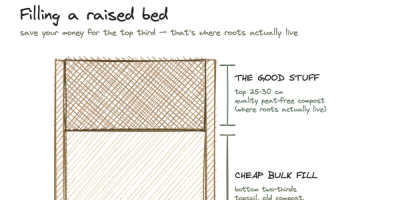
Understanding soil is the in-ground case. If you're working with raised beds or pots, though, you're building a growing medium from scratch — and the mix you fill them with matters more than most beginners realise.
That's the next piece →.
Further reading
Royal Horticultural Society — Soil types
Charles Dowding — No Dig: Nurture your soil to grow better veg with less effort (DK, 2022). The clearest modern case for mulching and minimal disturbance.
Garden Organic — Soil management
Oregon State University Extension — Improving garden soils with organic matter
Jeff Lowenfels & Wayne Lewis — Teaming with Microbes (Timber Press, 2010). A readable introduction to the soil food web for curious gardeners.