Growing guides
Getting your beds ready to grow

Preparing your beds and pots
You've picked the spot and decided on a bed type. Now comes the step most first-year gardeners skip past in a hurry: what goes in it — or, for in-ground beds, how to turn a patch of lawn or weeds into something you can actually plant.
Getting this right isn't complicated. It just takes a little thought before you reach for a shovel.
What you're actually building
When you fill a raised bed or a pot, you're not adding soil in the normal sense. You're building a growing medium from scratch — a living mix that holds water but drains excess, stays loose enough for roots to push through, and carries enough food to feed your crops for a season.
A good mix has three jobs: hold water, let air through, and feed plants. Get all three right and the rest of gardening becomes forgiving. Get any of them wrong and nothing else you do will save the crop.
Starting an in-ground bed — the no-dig way
If you're working with bare ground — a patch of lawn, an overgrown corner, or a tired old flower bed — there are several ways to turn it into a vegetable garden. Traditional digging, double digging, rotavating. The easiest by far is Charles Dowding's no-dig method, and it's the one most experienced gardeners are switching to.
The idea is simple: instead of digging up the soil, you smother whatever's growing there and build on top.
Clear the surface. Mow or strim whatever's there as low as you can.
Cover with cardboard. Lay sheets of plain cardboard (remove any tape and staples) over the entire area, overlapping generously so nothing pokes through. This smothers grass and weeds by blocking light.
Pile compost on top. Spread 15 cm or more of compost over the cardboard. This is what you'll plant into.
That's it. You can plant straight into the compost as soon as it's down. The old turf or weeds die underneath without you ever turning a spade, the cardboard breaks down over a few months, and the soil below quietly improves as worms pull the organic matter down. Dowding has tested this with rigorous side-by-side trials over many years — no-dig beds grow just as well as dug beds, with far less weed pressure.
Filling a raised bed
For a raised bed you have a choice between the cheap way and the good way, and both are legitimate.
The cheap way. Fill the bottom two-thirds with whatever you can get cheaply — bulk topsoil from a local depot, spent compost from last year, or a trailer-load from your council's green-waste facility. Roots mostly grow in the top layer anyway, so the bottom just needs to hold moisture and not compact into bricks. Then top the bed with 20–30 cm of good stuff: a quality peat-free compost, ideally mixed with a bit of well-rotted manure or leaf mould if you can find it. That top layer is where your plants actually live in year one.
The good way. Fill the whole bed with a proven mix — roughly two parts good topsoil to one part compost. More work, more cost, but no weak layer underneath to limit your roots later. Worth it if the bed is permanent and deep.
A few things to avoid either way:
Cheap "topsoil" from a builders' merchant. It's often lifeless fill — subsoil, rubble, sour clay. Ask where it came from. If they can't tell you, walk away.
Compost that smells sour or like ammonia. That's anaerobic, meaning low in oxygen — spread it out to air for a few weeks before using, or use it elsewhere.
Peat-based compost. Peat bogs take thousands of years to form and lock up enormous amounts of carbon. Peat-free is now the norm from any reputable brand, and in the UK sales of peat-based bagged compost to gardeners were banned in 2024. Just buy peat-free.
Filling a pot or container
Containers are a different game. The volume is smaller, the root zone is tighter, and the whole thing dries out faster than a raised bed ever will.
Three rules make it simple.
Use a proper potting mix, not garden soil. Garden soil compacts hard in a pot, chokes the roots, and drains badly. A peat-free multi-purpose compost from a garden centre is what you want.
Bigger is better. A 30-litre pot buys you a day between waterings in July. A 10-litre pot might ask for water twice. If you're choosing, always go bigger.
Feed as the season goes on. Potting mix starts with about six weeks of food built in. After that, a weekly liquid feed (tomato feed is fine for almost anything fruiting) makes the difference between a good crop and a tired one.
Between seasons, top up each pot with a few centimetres of fresh compost. The medium shrinks and tires out across a year, and a top-up renews it cheaply.
Where to actually get the stuff
Four options, roughly in order of cost:
Your local council's green-waste depot. Often the cheapest source of compost in real volume, sold by the trailer-load. Quality varies — ask other gardeners in your area which depots are worth a trip.
Bagged peat-free compost from a garden centre. Convenient, consistent, more expensive per litre. Fine for small jobs and container work.
Your own compost heap. Free, the best stuff you'll ever use, and takes about a year before it's ready. Start one now for next year.
Worm castings or leaf mould. Gold standard, usually only available in small quantities, best used as a top-dress or amendment rather than bulk fill.
A useful rule: don't pay garden-centre prices for bulk fill. Use cheap sources for volume, good sources for the top layer where it matters.
What's next
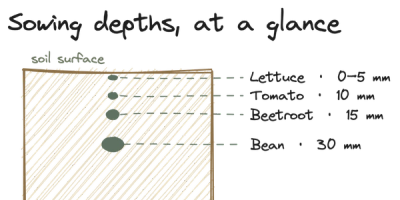
Filling a bed well is half the battle. The other half is getting seeds into it at the right time, and at the right depth — which is the next piece →.
Further reading
Royal Horticultural Society — Raised beds and Container gardening
Garden Organic — Making your own potting compost
Charles Dowding — No Dig: Nurture your soil to grow better veg with less effort (DK, 2022). The definitive guide to no-dig bed preparation, with step-by-step photos and trial results.
Monty Don — Down to Earth (DK, 2017). A patient explainer of the difference between topsoil, compost, and potting mix, and when each belongs where.