Growing guides
When and how to sow: a practical guide

When and how to sow: a practical guide
Sowing a seed is the easiest thing in gardening and the one that goes wrong most often.
Most of the disappointments new gardeners run into start at the seed stage — things that didn't germinate, germinated unevenly, or came up then keeled over a week later. Almost all of it comes down to a handful of small decisions made slightly wrong: depth, temperature, moisture, timing. Get those right and most seeds want to grow, almost whether you pay attention to them or not.
Here's what's worth knowing in plain language.
Read the seed packet like it's a contract
Seed packets are full of small type and you'll be tempted to skim. Don't. There are four numbers on the back that matter more than anything else you'll do that day.
When to sow. Usually given as a window ("March to May") or as weeks-before-last-frost. Sow outside that window and you're fighting the season — the season will win.
Sowing depth. Measured in millimetres or centimetres. Lettuce wants to be barely covered; a bean wants 2 cm down; a potato wants to be properly buried. More on this in a minute.
Spacing. Between seeds, and between rows. The numbers look absurdly generous; they aren't. Crammed plants turn into a forest of pale, sickly versions of what the photo promised.
Days to germination / days to harvest. The first tells you how long to be patient before you panic. The second tells you when to expect food.
The "when to sow" window on a packet is generic — it assumes an average European or North American climate. If you'd rather work from your own garden's conditions, the Ortaia app adjusts the timing to your location — it works from estimated frost dates, daylight conditions, and local weather to suggest when each crop is ready to go in. Either way, the point is the same — don't guess.
Depth: the single most common mistake
Get depth wrong and nothing else matters. Too deep and the seed exhausts its energy reserves trying to reach the light. Too shallow and it dries out or washes away.
A rule of thumb that holds for most vegetables: cover a seed with about two or three times its own diameter. A bean is roughly a centimetre across, so it wants 2 to 3 cm of soil over it. A lettuce seed is almost invisible, so it wants almost no covering — just a press into the surface and a light dusting.
A quick reference for the crops most often asked about:
Surface sow / barely cover (0–5 mm) — lettuce, basil, celery, dill, oregano, thyme, sage, chamomile, marjoram. These need light to germinate; cover them and they'll sulk.
Shallow (5–15 mm) — tomato, pepper, chilli, carrot, parsley, coriander, rocket, kale, broccoli, cabbage, cauliflower.
Medium (1–2.5 cm) — beetroot, spinach, leek, onion (seed), swiss chard, parsnip, cucumber, courgette, radish.
Deep (2.5–5 cm) — bush beans, climbing beans, corn, butternut squash, pumpkin.
Very deep (5 cm and more) — peas (3–5 cm), garlic cloves (5–8 cm, pointed end up), potato tubers (10–15 cm).
These are ranges, not laws. If in doubt, err shallow rather than deep.
Direct sow vs module sow
Two basic options, each with a personality.
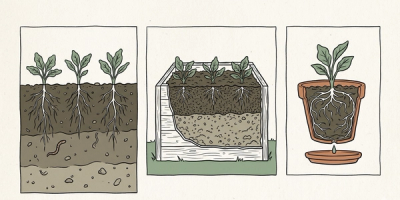
Direct sowing means putting seeds straight into the ground where you want the plant to grow. Fast, no pots or compost needed, and best for crops that hate being transplanted — carrots, parsnips, radishes, beetroot, and most of the bean family. The trade-off: you're at the mercy of weather, slugs, and patchy germination, and you'll need to thin later, which feels cruel the first time.
Module sowing (also called cell sowing) means starting seeds in small pots or trays somewhere warm and sheltered — a greenhouse, cold frame, or sunny windowsill — then transplanting the young plants out once they're robust. Slower, but far more control. You know exactly how many plants germinated, you can protect them from slugs and cold until they're tough, and you can plant them at the spacing you actually want.
A useful default: direct sow anything fast and root-heavy; module sow anything slow, tender, or eaten by slugs.
Warm, moist, and honest
Three non-negotiables once seeds are in the compost.
Warmth. Most veg seeds want soil between 15 and 25°C to germinate. Peppers and chillies want the upper end. A windowsill above a radiator, a heat mat, or simply waiting another two weeks until spring catches up will all solve the same problem.
Moisture, not sogginess. Compost should feel like a wrung-out sponge. Water gently with a mister or a fine rose so you don't blast seeds out of place. Cover trays with a clear lid or plastic bag until germination, then take it off the moment you see green.
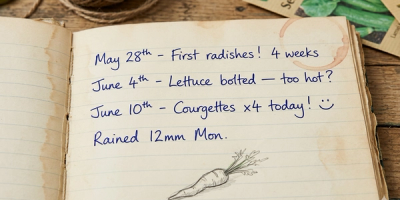
Honesty with yourself. Most seed failures aren't mysteries — the compost dried out while you were at work, or the tray cooked on an afternoon-hot windowsill. Write down what you sowed, when, and what happened. The Ortaia app or a notebook will both do the job.
Thin, pot on, harden off
A seedling has three phases after it germinates, and each wants a little attention.
Thin. If you direct sowed and too many came up, pull or snip the weakest to leave the survivors at packet spacing. Don't skip this — crowded seedlings grow into thin, spindly, underwhelming plants.
Pot on. If you module sowed, once roots fill the cell the plant wants a bigger home. Tip it out; if the rootball is knitted solid, it's ready. Move it into a larger pot with fresh compost, water it in, and give it a few days.
Harden off. Before a module-grown plant goes into the outdoor bed, it needs to adjust to wind, sun, and cooler nights. Put it outside in a sheltered spot for a couple of hours on day one, four on day two, a full day by the end of the week. Skipping this step can set a plant back two weeks or kill it outright. It's the last small discipline and the one most often forgotten.
The short version
Read the packet. Don't bury seeds too deep. Sow at the right time of year, not when you feel like it. Keep the compost moist and warm until they come up. Thin without guilt. Harden off before transplanting. Write everything down.
Do those, and the seeds will do the rest. They genuinely want to grow. Your only real job is to stay out of the way.
What's next
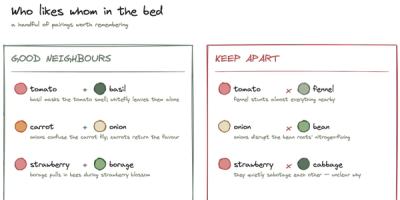
Getting seeds into the ground is only half of planting — the other half is where you put each one. Some crops help their neighbours. Others quietly sabotage them.
That's the next piece →.
Further reading
Royal Horticultural Society — Sowing vegetable seeds outdoors and Sowing seeds indoors
Thompson & Morgan — Seed sowing guide
West Coast Seeds — How to start seeds
Charles Dowding — Charles Dowding's Vegetable Course (Frances Lincoln, 2020), chapters on seed starting and transplanting